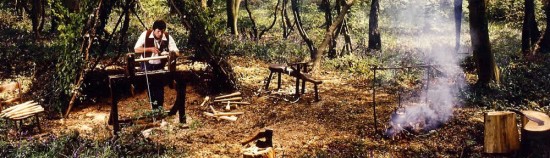
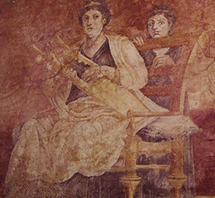
 Woodturning has played more than a supporting role in the history of chair making. From the ancient Egyptians, who used the lathe for turning chair parts, to the latest computer-controlled copy lathes man has endeavored to decorate his furniture and solve the practical turning problems that arise.
Some of the earliest evidence of turned work in English chairs date from the twelfth Century where a chair of state is depicted in an illuminated manuscript written by Eadwine, a monk from Canterbury.
Every turned component is covered by a mass of ‘bobbin and bead’ decoration. Bobbin ornament was very popular with early turners as it was easy to achieve and did not demand sophisticated tools. By the sixteenth century chairs became more numerous, particularly a triangular seated variety referred to as a ‘thrown’ chair. This was every inch a ‘turners‘ chair with virtually every component turned and ornamented on the lathe. The paintings of Pieter Bruegel show that these chairs were quite common in Dutch cottages and Inns of the mid-1500s. The term ‘thrown’ is descriptive of the wood being ‘spun’ in the lathe, pots are still ‘thrown’ on a potters wheel today.
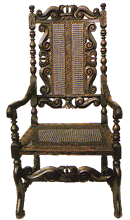 The components of these early chairs were pole lathe turned and were the equivalent of the massed produced Windsor chairs of the 18th and 19th century’s in England. Although animal glue, sometimes combined with wedges were used in Windsor chair construction to keep the whole thing together turned chair parts of earlier century’s were normally just pegged.
By the 17th century well-proportioned baluster turned legs with elegant beads, coves and swells were being incorporated into the oak furniture of the time. Well before the century had ended the turner was playing a significant role producing high quality work, often in the newly fashionable Walnut. Legs and chair backs with barley-sugar twists are an example of this. Twists themselves were not turned but carved and rasped from a turned cylinder that had previously been carefully measured and marked. This was a time consuming practice and required great skill, especially when we consider that these 17th century twists were made in mirror image sets for esthetic balance.
Towards the end of the Victorian era a Semi automatic lathe was invented to produce twists and by the 1920s the demand for reproduction Oak furniture was high. Sir Lawrence Weaver observed in 1929’ when writing about the High Wycombe furniture trade that:
“There are other odd little corners of work where the hand still prevails. Because the Jacobean cult is still so much loved, Ingenious lathes work the twisted baluster that gives the ‘Tudobethan’ flavour. But the lathe has not learned to do the job quite cleanly. So there is a pleasant profession amongst women in High Wycombe, the profession of twist cleaning-so prosperous that a few weeks ago enquirey at the Labour Exchange revealed only one twist cleaner not cleaning twists”.
This cleaning work entailed rounding off the flat facets left by the lathe cutter attachment using rasps, scrapers and sandpaper.
Off-centre turning was employed in a variety of ways, one was to create a form of Cabriole leg for instance. True Cabriole legs are mostly the result of sawing on two faces and shaping with drawknife and spokeshave with may-be a ‘ball and claw ‘feature carved at the foot. The ‘pad foot’ variety is the only version to incorporate any turning at all, in this case the foot is turned off Centre before the leg is sawn to shape. The turned foot is then gracefully incorporated into the rest of the leg using hand tools. Today, many simple cabriole legs found on cheaper furniture are the result of being produced on automatic copy lathes.
There is a form of cabriole leg that is wholly lathe turned using off Centre techniques. These have often been derided by connoisseurs in the past as being a poor substitute for the real thing, but they do have their place in furniture history.
‘Best forefeet’ is not a term that occurs in general conversation much these days but from the mid Victorian period they were much desired as a refined feature on bedroom and parlor chairs.
 The foot of this style of chair leg curves outwards in a long tapering elegant sweep and gives the appearance of being cleverly turned on the lathe. At first glance these ‘best forefeet’ appear to be the result of some clever off-Centre turning. The actual method employed was simple; enough extra wood was left where the toe would be for it to be shaped by hand after the remaining leg had been turned. The turned leg would be held in a vice and carefully shaped using spokeshaves and stock scrapers until the curved toe was blended into the turned portion.
Producing best forefeet was also part of the chair Bodgers repertoire. In the Sam Rockall collection there are two pairs showing quite clearly the two main stages of shaping. It is quite likely that most of these legs were delivered to the factorys where ‘Bench men’ shaped the ‘toe’ once the legs had seasoned.
The term ‘Backfoot’ is misleading as it refers to the back leg of a chair that continues in a curve to also form the chair back. The actual leg portion is usually left square but the section above the seat that forms the back is often turned. To turn the straight section of a curved component quickly and repetitively requires a simple solution. The answer was the ‘Turners Buckle’, a quick release devise, as simple in it’s conception as it was in operation. The main component was a profiled block of wood that operated as an extension to bring the turned portion back in line with the lathe centers. This was held in place with a hand forged rectangular steel link and wooden wedge. The ‘Turners Buckle‘ was used on both pole and power lathes.
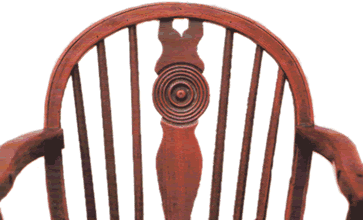
Many years ago I attended a lecture on antique furniture and when a picture of a certain Windsor chair appeared on the screen, the lecturer said that maybe in the future the tool that produced this circular moulding would come to light. The decoration he was talking about is known as a ‘Bulls eye’ and is a solid device sometimes used instead of the more common pierced wheel as found on many wheelback Windsor chairs. The answer to the lecturer’s conundrum was that there never was a ‘special tool’ but that these ‘Bulls eyes’ were turned on the lathe.